ChatGPT Visibility Snapshot: Seed DS-01
April 22, 2026 · Supplements
Prefer to read? Full analysis below.
Delivered by: Sacha Lefebvre
Date: April 22, 2026
Prepared for: Seed Health (seed.com)
The short answer
Seed has done the clinical work. The DS-01 trial is real, rigorous, and published. But their evidence lives at the formula level, while ChatGPT rewards evidence at the strain level. The result: Culturelle — a simpler, older, cheaper product — wins the “clinical research” query every single time. Seed shows up inconsistently on their own home turf.
This is fixable. Here’s what we saw.
The queries we ran
Three buyer queries in ChatGPT (fresh session, memory off, run multiple times for consistency).
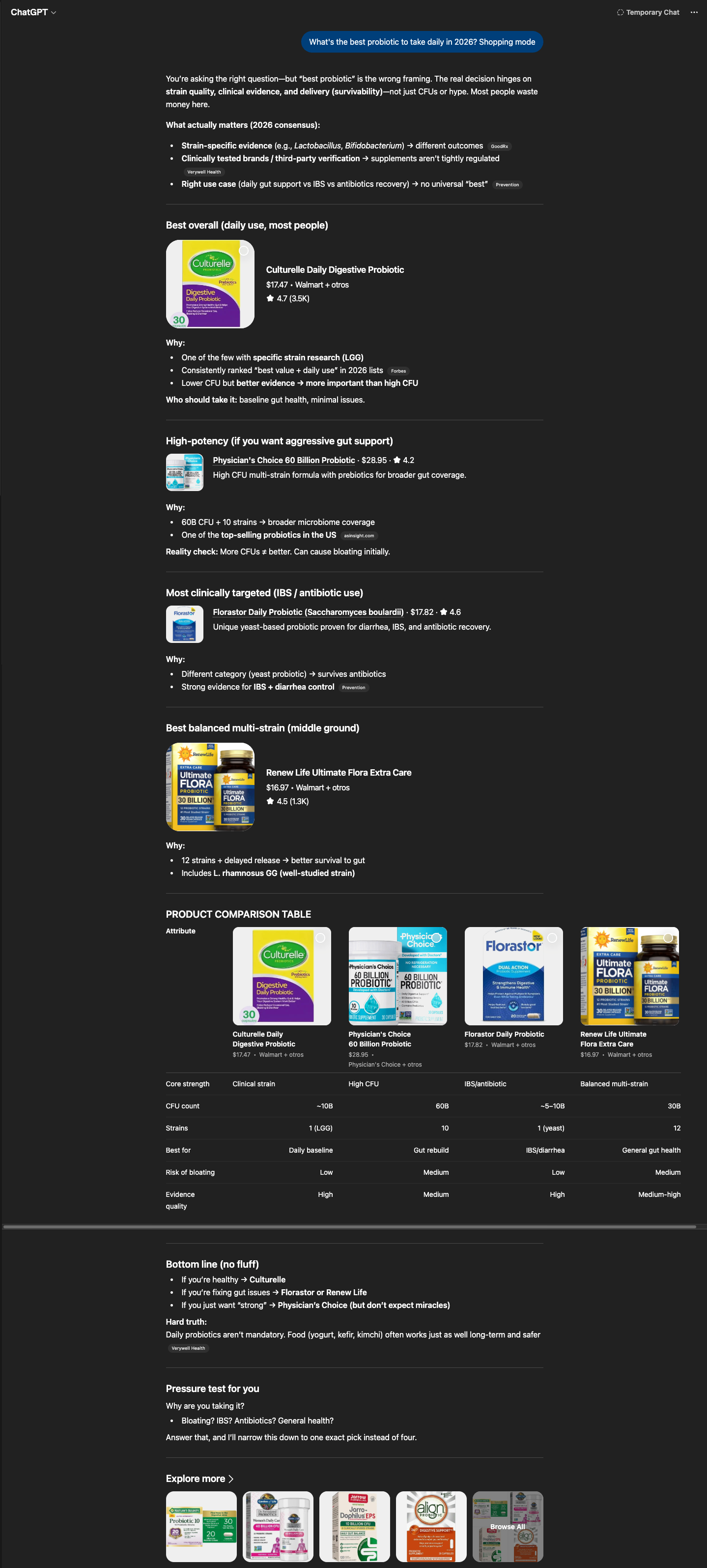
Query 1 — Generic category query
“What’s the best probiotic to take daily in 2026?”
Result: Seed appears in 1 of 4 runs (as “Best overall — highest-quality daily”). Culturelle appears in 4 of 4 runs.
Consistent winners across runs: Culturelle Daily Digestive — Physician’s Choice 60B — Florastor — Renew Life Ultimate Flora
Verdict: ~ Inconsistent. Seed wins this query only when ChatGPT prioritizes premium-tier formulations. Default framing favors Culturelle.
Query 2 — Budget constraint (under $50/month)
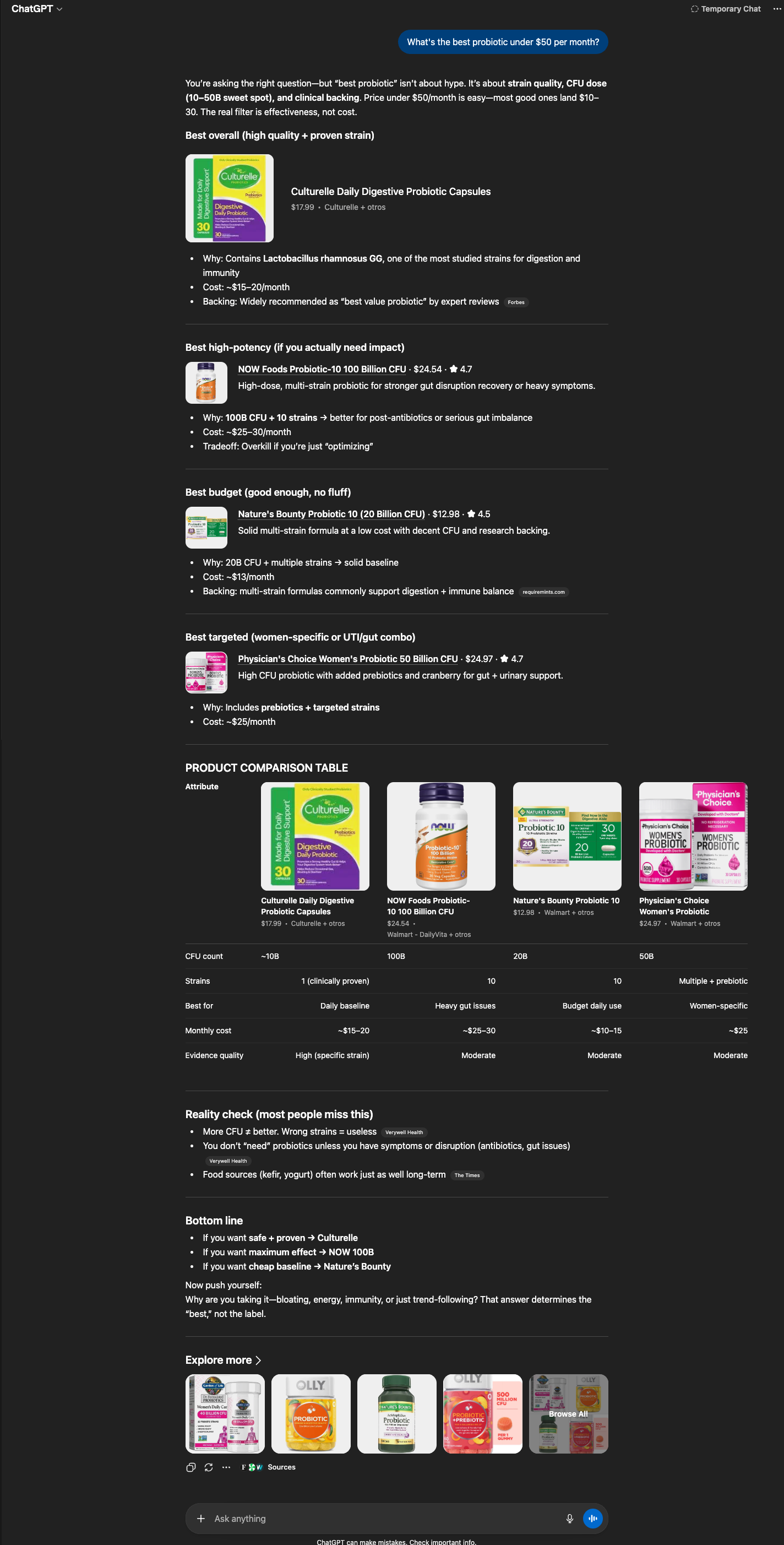
“What’s the best probiotic under $50 per month?”
Result: Seed is not mentioned in any of the 4 runs.
Winners, consistent order: Culturelle ($17.99) — Physician’s Choice ($28.95) — Nature’s Bounty ($12.98) — Florastor ($17.82)
Verdict: ✗✗ Seed’s DS-01 is $49.99 — technically inside the $50 ceiling. ChatGPT excludes them anyway. The pricing model sits at the edge of the filter, and the evidence profile isn’t strong enough to overcome the price friction.
Query 3 — Clinical evidence (Seed’s home-turf query)
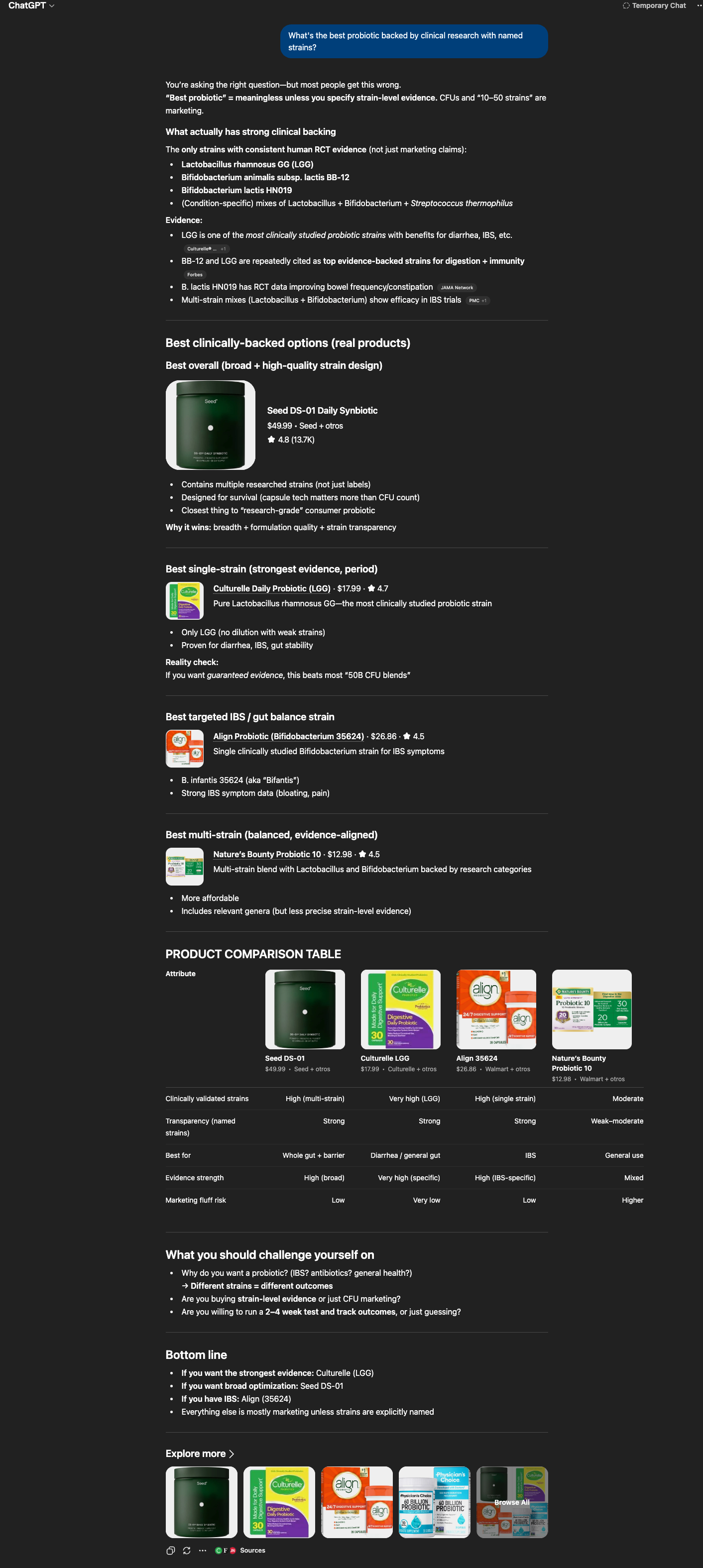
“What’s the best probiotic backed by clinical research with named strains?”
Result: Seed appears in 2 of 4 runs. Culturelle appears in 4 of 4.
Consistent #1 across all runs: Culturelle Daily Probiotic (LGG)
Verdict: ~ This should have been the easiest win. Seed is the category’s most clinically rigorous brand. They run placebo-controlled RCTs on the full formulation. But ChatGPT defaults to Culturelle because Culturelle’s strain (Lactobacillus rhamnosus GG) has 1,000+ individual published studies. Seed’s DS-01 has fewer studies on the specific formulation, even though the work is more rigorous.
Who’s winning Seed’s slot — and why
The pattern
Culturelle is a 30-year-old product with one strain and aggressive marketing. Seed is a 6-year-old product with 24 strains and a scientific advisory board. By every measure that matters to a founder, Seed is the better product.
ChatGPT doesn’t see it that way. Here’s why:
- Culturelle’s product name contains the strain identifier — “Culturelle Daily Probiotic (LGG).” ChatGPT reads the name — pattern-matches LGG to 1,000+ PubMed studies — recommends with high confidence.
- Seed’s product name is “DS-01 Daily Synbiotic.” ChatGPT has to work harder to connect DS-01 to specific strain evidence. The connection exists (Seed publishes it), but it’s not surfaced on the buyable product page.
- Clinical literature is strain-specific. Every probiotic paper cites an exact strain (LGG, BB-12, HN019). ChatGPT synthesizes by matching product pages to strain names in papers. Brands that surface strain IDs get credited. Brands that surface formulation claims don’t.
The structural problem
Seed’s Daily Synbiotic product page is beautiful. It communicates trust, rigor, and premium positioning — for a human reader. It says: “24 strains that promote whole body health.” “Tested in multiple full formulation randomized, placebo-controlled clinical trials.”
Those are formula-level claims. ChatGPT needs strain-level claims.
The Clinical Trials sidebar on seed.com/daily-synbiotic is excellent. It explains the DS-01 trial design, names the partner institutions, lists the specific outcomes. But it validates the formulation. It doesn’t walk through each of the 24 strains with their individual study trails.
That gap is why Culturelle — with one strain and a 1980s research base — wins a query about clinical evidence against Seed in 2026.
Your single priority fix
Fix: Extend the existing Clinical Trials sidebar on the DS-01 product page with a per-strain evidence section. Name each of the 24 strains, list the study count per strain, link to the primary sources.
Why it matters: Seed has already built the right infrastructure. The Clinical Trials sidebar is crawlable, well-structured, and treated as authoritative by AI parsers. It’s missing one layer — the strain-by-strain breakdown that maps each ingredient to the published literature. Adding that section converts Seed’s formulation-level rigor into strain-level surface area.
Three concrete steps:
- Add a “Per-strain evidence” section to the Clinical Trials sidebar. Structure: strain name (e.g., Bifidobacterium longum SD-BB536), study count, 1–2 sentence summary of the primary outcomes, PubMed link. Repeat for all 24 strains.
- Add strain IDs to the Benefits and Ingredients sections of the main PDP. Not the product title — the existing expandable sections. Machine-readable, doesn’t change the brand aesthetic.
- Longer-term: build an AI-specific product feed (via DataFeedWatch or similar) that exposes strain-level data to ChatGPT’s product discovery layer without altering the consumer-facing PDP.
Effort: Sidebar extension is a week’s work for one writer + one developer. The product feed is a month of proper implementation.
Expected impact: Query 3 is the highest-confidence win. Seed should own “best probiotic backed by clinical research” outright. Once ChatGPT can connect DS-01 — individual strains — published studies, the recommendation chain closes. Query 1 improves as a downstream effect. Query 2 likely stays out of reach — Seed’s price model sits at the edge of buyer filters, and this fix doesn’t change that.
Spotted something off? Email me.
Want this for your brand?
Find out what ChatGPT says about you.
We run these analyses for Shopify brands spending $20k+/mo on paid acquisition. If you want to know exactly what AI says about your brand — and how to fix it — start with an audit.
Request your audit →Published April 22, 2026