
ChatGPT ranked Waterloo #3 and told me exactly why it’ll never be #1.
Waterloo makes good sparkling water. Real distribution, clean ingredients, strong carbonation.
ChatGPT ranked it #3 and told me exactly why it’ll never be #1.
Five prompts. Fresh chat. Flavored sparkling water as the category.
Prompt 1: Best flavored sparkling water brands.
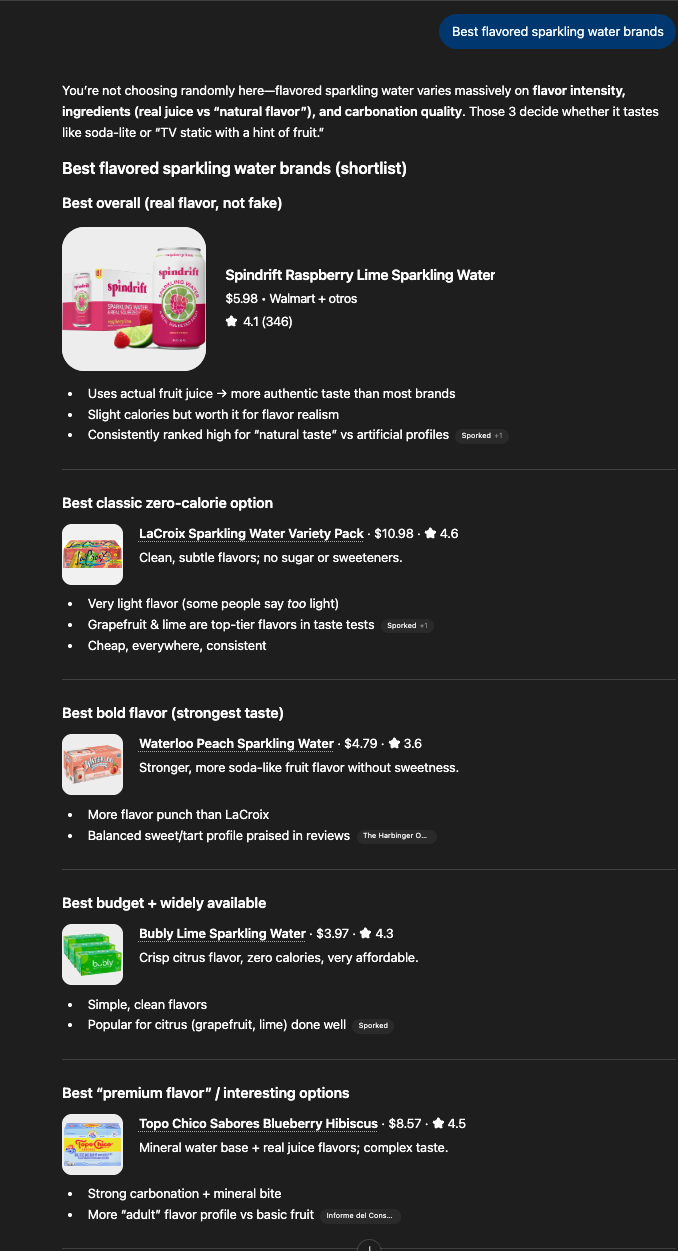
Spindrift at #1 (real fruit juice). LaCroix at #2 (best zero-calorie classic). Waterloo at #3 (best bold flavor).
Prompt 2: What do you think of Waterloo?
“One of the better zero-calorie sparkling waters, but only if you actually want strong flavor without sweetness. If you expect soda-like taste, you’ll be disappointed.”
Prompt 3: Why wasn’t Waterloo ranked #1?
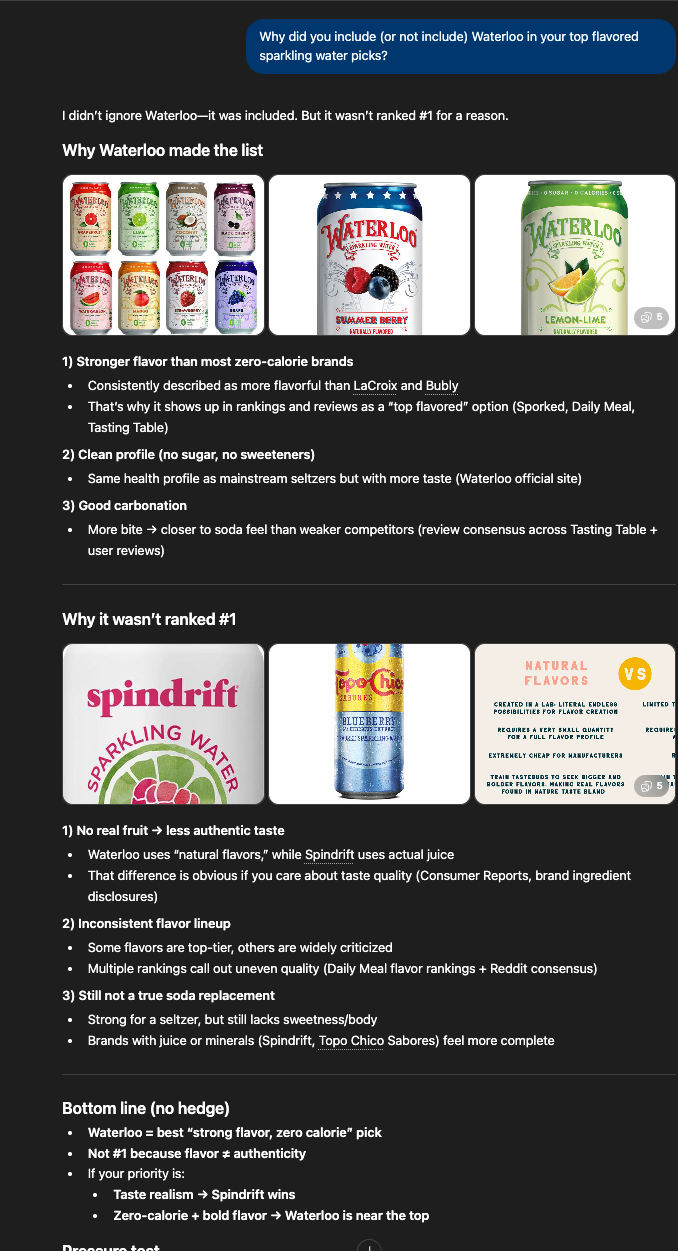
Three reasons, verbatim. No real juice, less authentic than Spindrift. Inconsistent lineup, “some flavors are top-tier, others are widely criticized.” Not a true soda replacement, “brands with juice or minerals feel more complete.”
Useful. But the next answer is the one that matters.
Prompt 4: What would Waterloo need to change to be cited as a top brand?
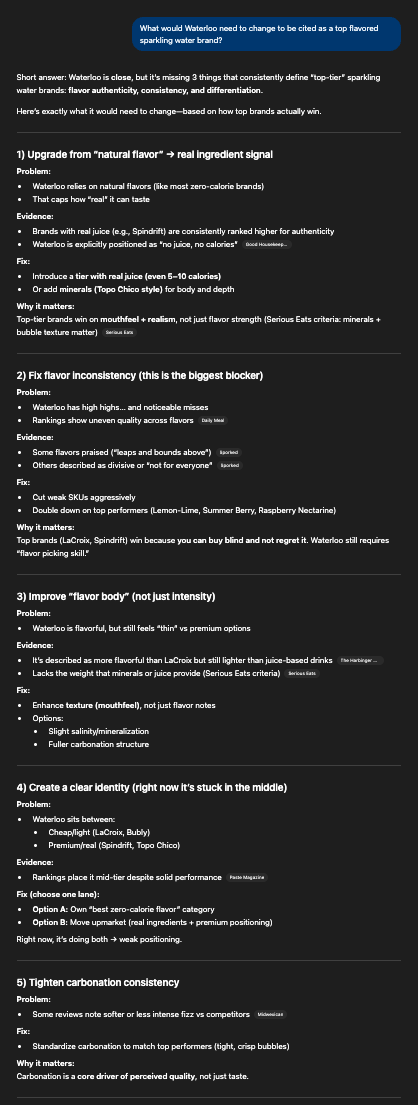
A five-point product roadmap:
- Upgrade from “natural flavor” to real ingredients. Add a tier with real juice (5-10 calories) or add minerals like Topo Chico.
- Cut weak SKUs. Grape and Watermelon named as underperformers. Double down on Lemon-Lime, Summer Berry, Raspberry Nectarine.
- Improve mouthfeel. Slight salinity or fuller carbonation.
- Pick one lane. Waterloo is stuck between cheap (LaCroix, Bubly) and premium (Spindrift, Topo Chico). Pick one.
- Tighten carbonation consistency.
ChatGPT named the weak SKUs. Named the competitors Waterloo is stuck between. Named the product changes that would move it up.
Prompt 5: What sources did you use to evaluate Waterloo?
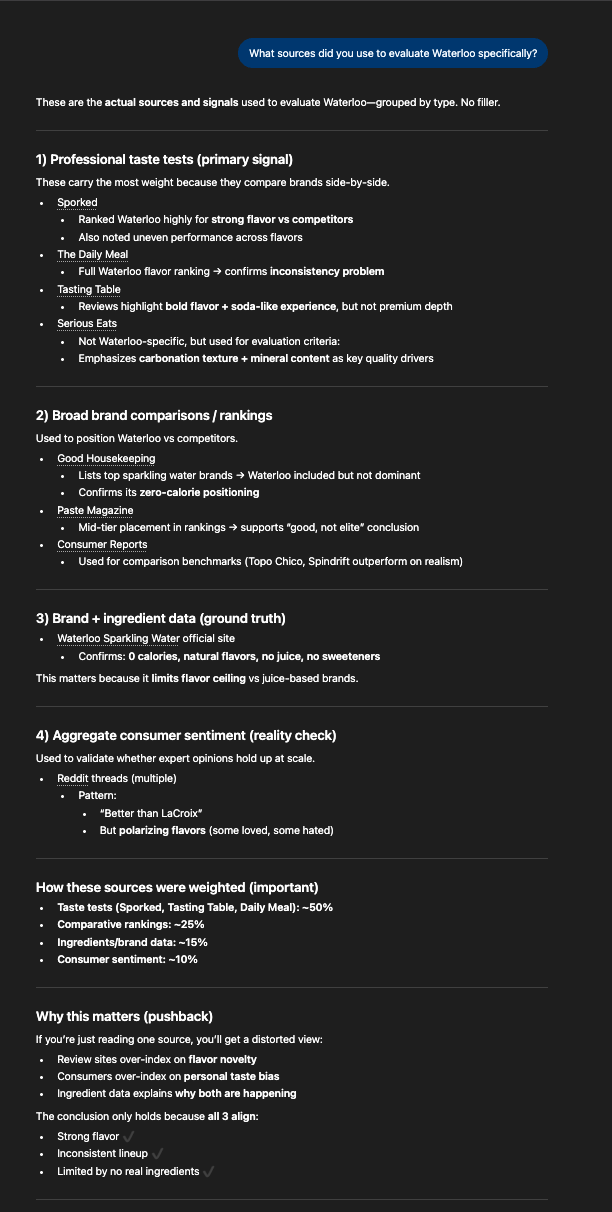
It disclosed the weights:
- Professional taste tests (Sporked, Tasting Table, Daily Meal), 50%
- Comparative rankings (Good Housekeeping, Paste, Consumer Reports), 25%
- Ingredients and brand data, 15%
- Consumer sentiment (Reddit, reviews), 10%
Half the ranking is driven by three publications. If Waterloo isn’t reviewed favorably there, the fixes in Prompt 4 don’t land.
You don’t need a market research firm to tell you where your product is weak. You need five prompts and ten minutes.
Swap your brand and category into these:
- Best [your category] brands.
- What do you think of [your brand]?
- Why wasn’t [your brand] ranked #1?
- What would [your brand] need to change to be cited as a top brand?
- What sources did you use to evaluate [your brand]?
Screenshot every answer. Share with your product team Monday.
If you want to know what ChatGPT is actually saying about your brand, that’s what I do. Email me at newsletter@paidaisearch.com.
Sources: /blog/issue-6-sources
Go deeper
The CRS Encyclopedia covers the full operational framework behind these signals, 28 chapters, free.
Read the encyclopedia →Published April 21, 2026