The paid channel is moving into the conversation
The buyer does not need to click before asking the real buying question anymore. That matters if you run paid for a Shopify brand, because ChatGPT is not a normal search page. It lets the buyer explain the job, the budget, the concern, and the product type in one sentence.
A normal search might be “chef knife.” A real ChatGPT buying question is “Best Japanese-style chef knife under $150 for a home cook with small hands.” That question gives the product, price, use case, buyer type, and worry before an ad ever appears.
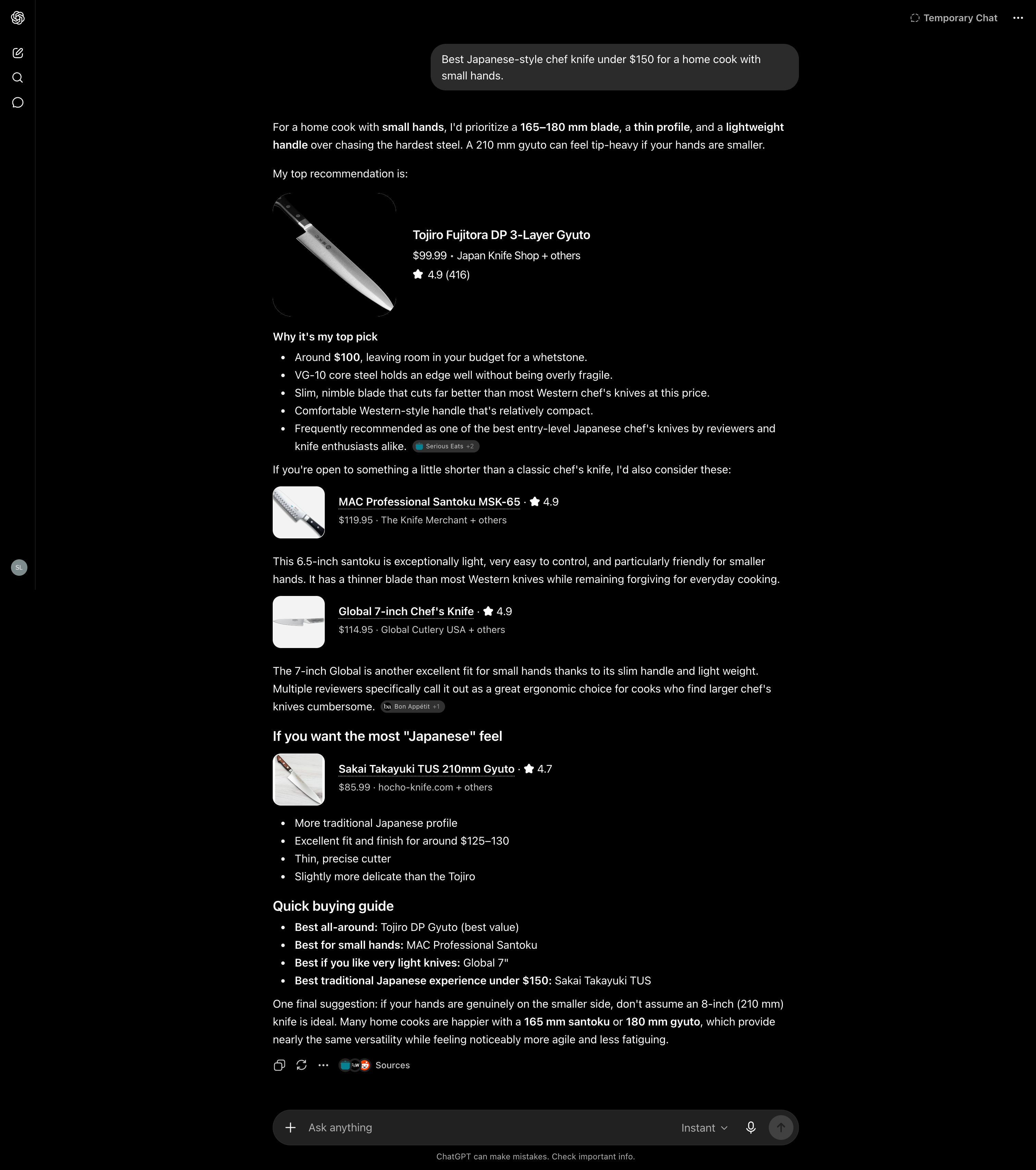
OpenAI says advertisers can create ChatGPT ads through partners or a beta self-serve Ads Manager, with cost-per-click bidding, which means paying when someone clicks, and tools to track campaign results (OpenAI, “New ways to buy ChatGPT ads,” May 5, 2026). OpenAI also says people use ChatGPT to explore what they need, compare options, and make decisions (OpenAI, “New ways to buy ChatGPT ads,” May 5, 2026). That puts the paid moment closer to the decision.
OpenAI made a Cannes Lions advertising push this week, pitching ChatGPT ads to marketers as part of a new ad business (Financial Times, “OpenAI pitches ChatGPT ads to Cannes marketers ahead of IPO,” June 23, 2026). Digiday also reported that OpenAI made shopping ads easier for ecommerce brands by letting retailers generate ads from product catalogues, which are product lists with names, images, prices, and attributes, instead of building every ad one by one (Digiday, “OpenAI makes it easier to run shopping ads in ChatGPT,” May 12, 2026).
So the question is not whether this paid channel is real. It is already being sold. The question is whether your Shopify store gives ChatGPT enough proof to match your product to the buyer’s question.
Most product pages are built for someone who already clicked. ChatGPT ads need the product to be clear before the click. That means clear names, prices, shipping, reviews, materials, sizes, and proof behind the claim.
If your knife page says “crafted for performance,” that is too soft. If it says “8-inch VG10 stainless steel chef knife, 58 HRC hardness, 6.8 oz weight, free sharpening for 12 months,” ChatGPT has something concrete to match. The same logic applies to skincare, apparel, supplements, home goods, and any Shopify category where buyers compare before they buy.
Google and Meta still matter. Keep them running if they are profitable. But ChatGPT ads are a new place where the buyer asks, compares, decides, and clicks inside the same conversation.
I help Shopify brands test ChatGPT ads while the channel is still early. If I do not beat your current Google or Meta CPA, which means cost per customer purchase, in month one, you do not pay month one.
Sacha
June 27, 2026 · Issue #20
Sources
OpenAI, “New ways to buy ChatGPT ads,” May 5, 2026 - https://openai.com/index/new-ways-to-buy-chatgpt-ads/
Financial Times, “OpenAI pitches ChatGPT ads to Cannes marketers ahead of IPO,” June 23, 2026 - https://www.ft.com/content/9717a042-fd09-4d08-972d-29b68f7985a4
Digiday, “OpenAI makes it easier to run shopping ads in ChatGPT,” May 12, 2026 - https://digiday.com/marketing/openai-makes-it-easier-to-run-shopping-ads-in-chatgpt/
Correction policy. If anything in this post is wrong, I’ll fix it inline and add a Correction line above this notice with the date, what was wrong, what’s correct, and the source. No silent edits.
Go deeper
The CRS Encyclopedia covers the full operational framework behind these signals, 28 chapters, free.
Read the encyclopedia →Published June 27, 2026